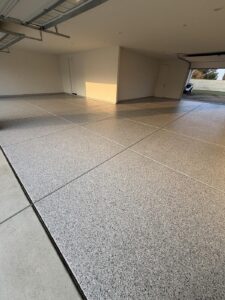
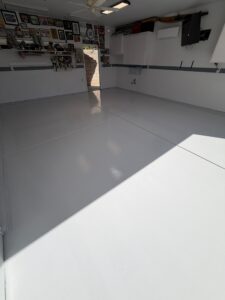
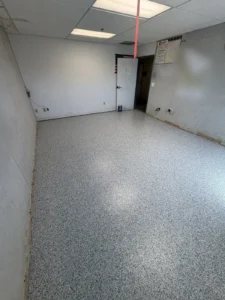
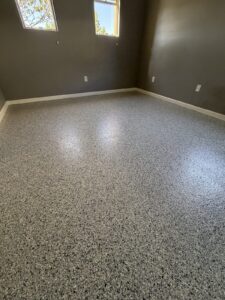
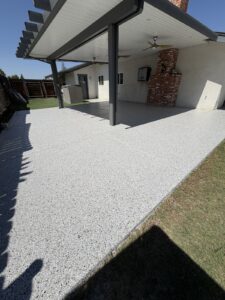
Most of what we post here is garages, patios and pool decks. But a good share of our work is commercial, and a commercial office floor coating comes with a problem a homeowner never has to think about: the building still has to open on Monday.
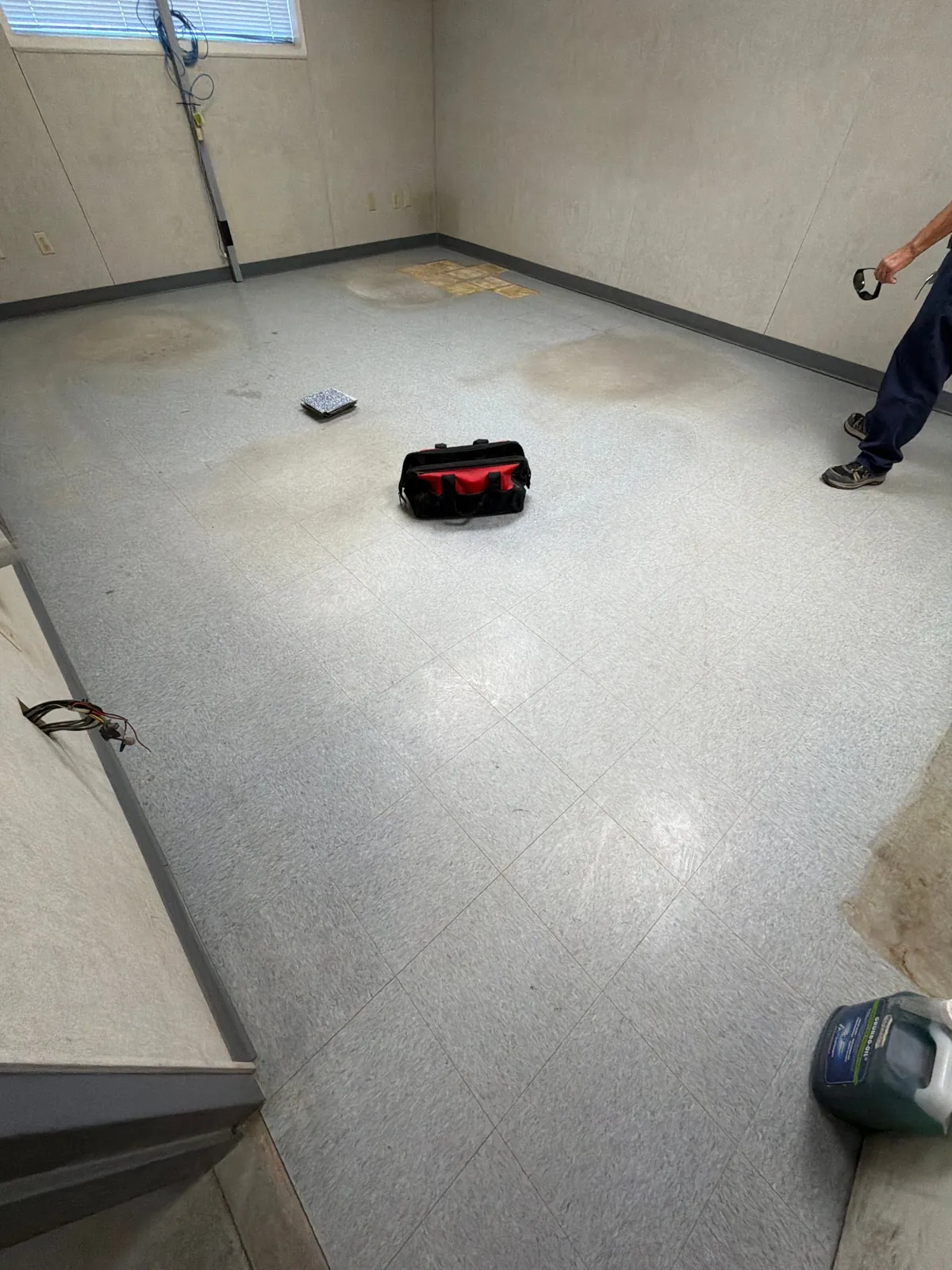
This one was a 350-square-foot office inside a working facility here in Kern County. The room was being turned into a cubicle space, and the floor underneath was old VCT tile — the twelve-inch commercial vinyl tile you’ve walked on in every office, school and clinic in the valley. It had to come out. Whatever went down in its place had to handle desks, chairs and daily foot traffic without ever needing to be stripped, waxed or refinished again.
Pulling Up the Tile and Prepping the Slab
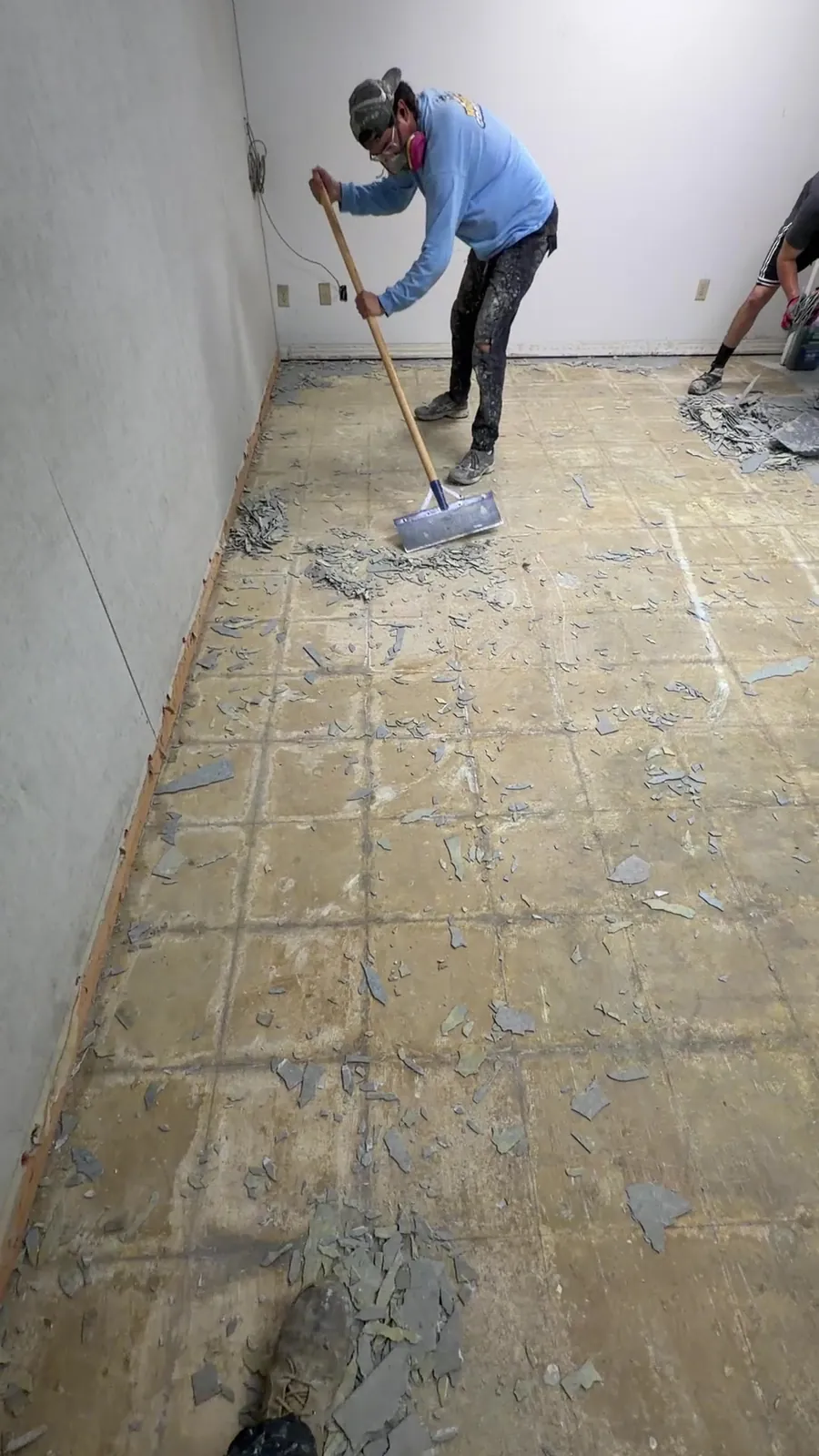
Day one was demolition and prep. We lifted the VCT off the slab, dealt with the old adhesive underneath, and mechanically prepped the bare concrete.
Prep is the part nobody sees and the part that decides everything. A coating cannot grip a smooth, sealed slab — it needs a properly profiled surface to bond into. Over a floor that’s had tile adhesive sitting on it for decades that matters even more, because any residue left behind becomes a weak layer, and a weak layer is where the finished floor eventually lets go. Get this step wrong and nothing you put on top of it can save the job.
The Tiles Told Us What Was Wrong
Here’s the part that decided how this floor got built. Tiles in that room had been popping loose off the slab.
That is a symptom, and it points at one thing: moisture. Concrete poured on grade is never really dry. Moisture rises out of the soil beneath it and moves up through the slab as vapor, continuously, year after year. Under vinyl tile it has nowhere to escape, so it collects at the adhesive line and breaks the bond — and tiles start lifting. Which is exactly what was happening.
Now think about what that means for a coating. Seal a slab like that and the vapor still has nowhere to go. It gathers underneath and pushes the coating off the concrete — bubbles, blisters, and eventually sheets of floor letting go. By the time you can see it, the only honest fix is to take the whole thing off and start over.
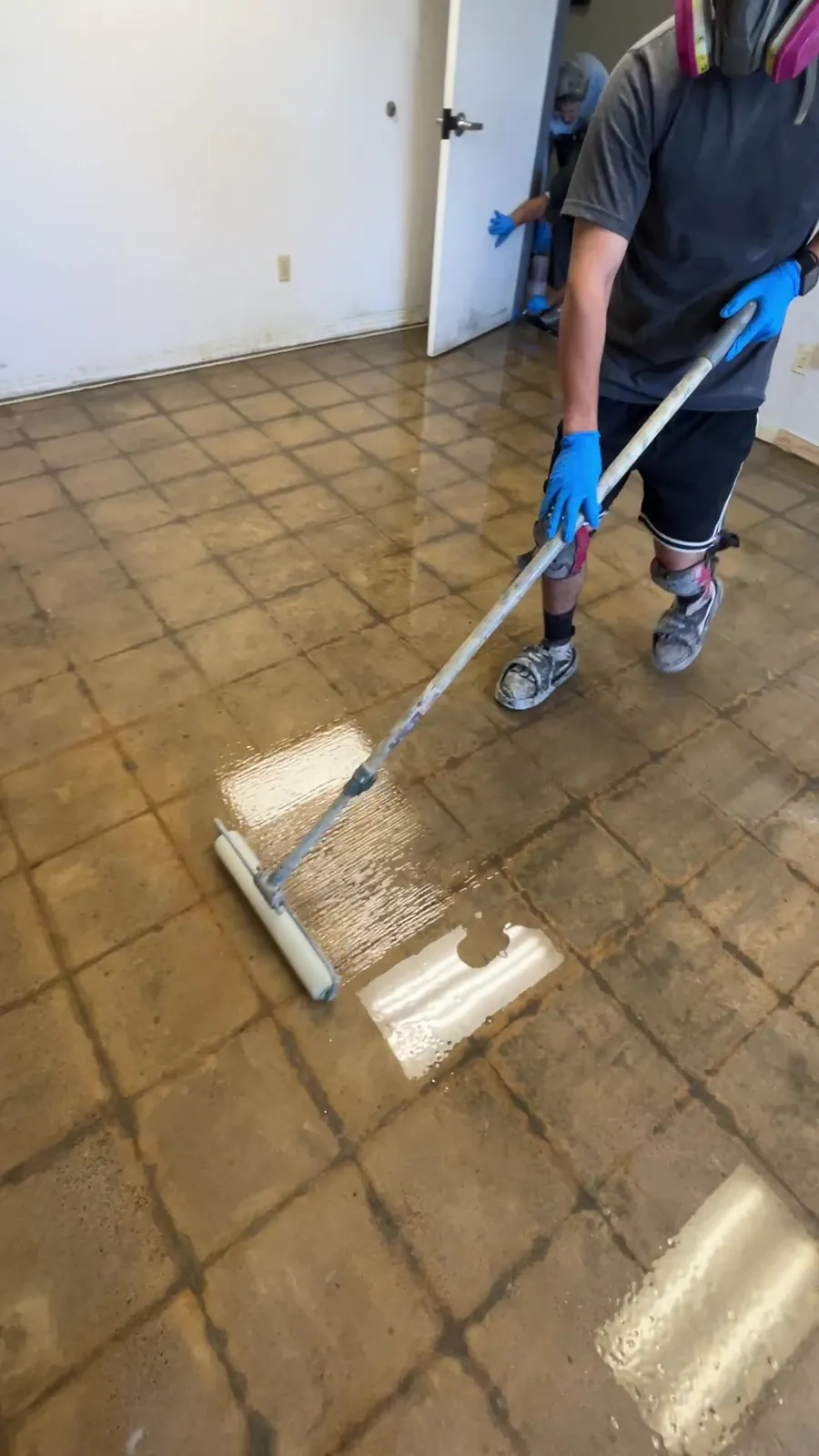
So before any color went down, still on day one, we installed a moisture vapor barrier: a dedicated layer that goes on first and stops the vapor before it ever reaches the coating. On this slab it was not optional. The floor had already told us what it was going to do.
The System: Polyaspartic, Torginol Lunar Flake and a Urethane Topcoat
This room got the best system we build. Day two was the floor itself. We rolled a polyaspartic base coat over the barrier and broadcast Torginol’s Lunar flake into it while it was still wet, working the room so the coverage stayed even wall to wall.
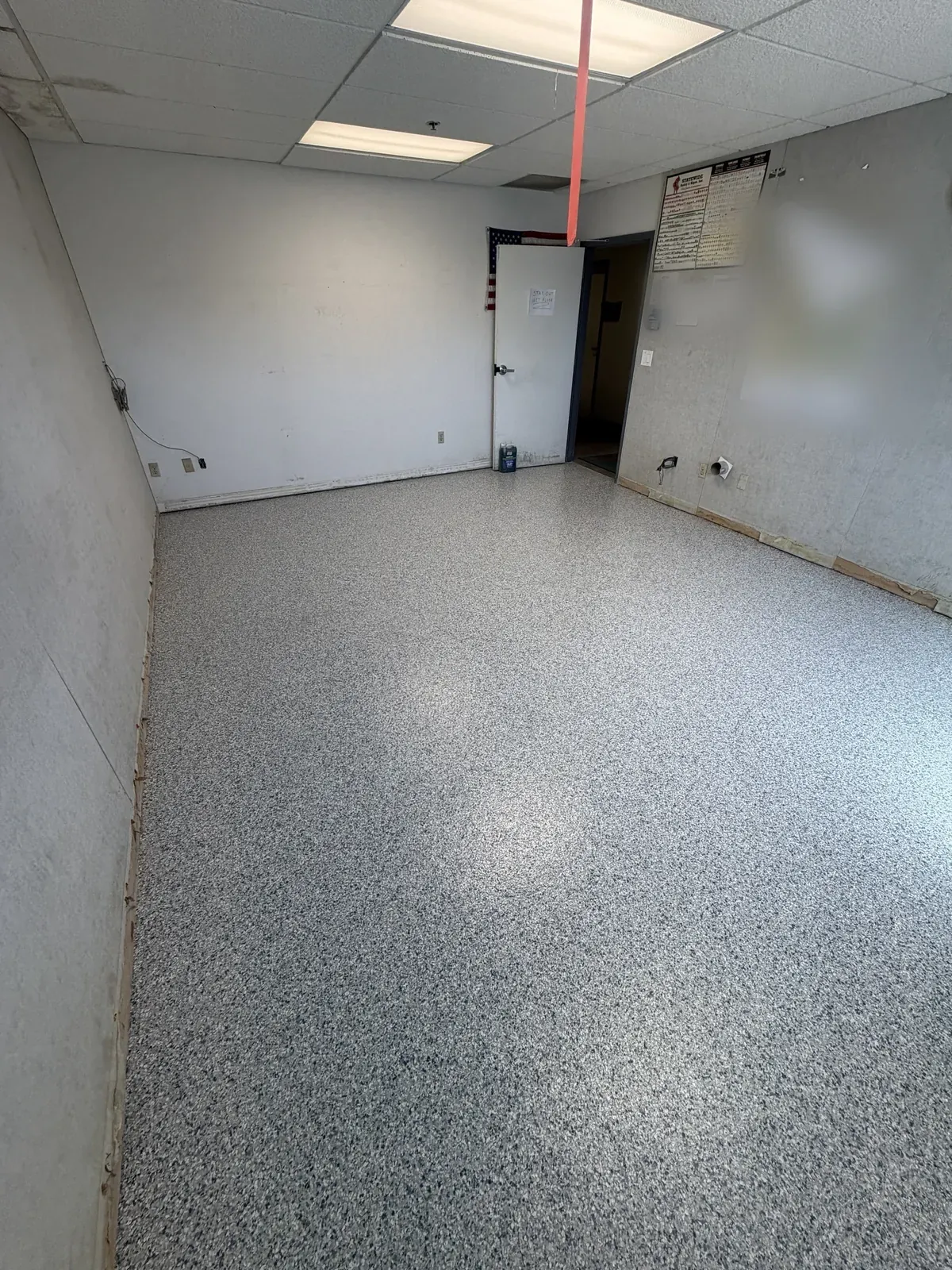
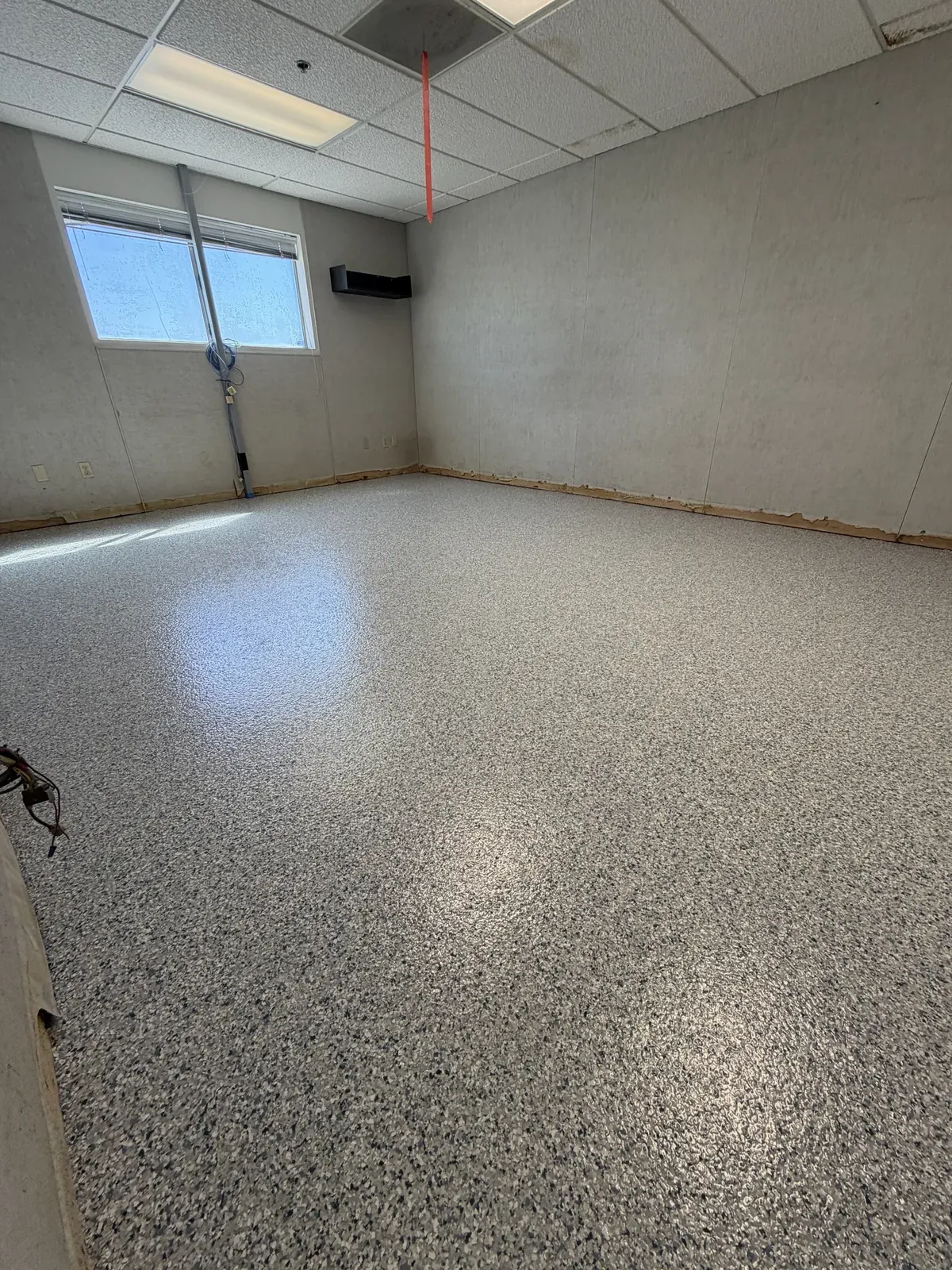
Lunar is a grey-and-white blend, and it’s a smart pick for an office. It reads clean and bright under fluorescent lighting, it won’t fight with whatever color the cubicles end up being, and the flake pattern does something a solid color can’t — it breaks up the surface so everyday scuffs, dust and the odd coffee splash simply don’t show. Our color chart has the rest of the blends if you want to see what else is available.
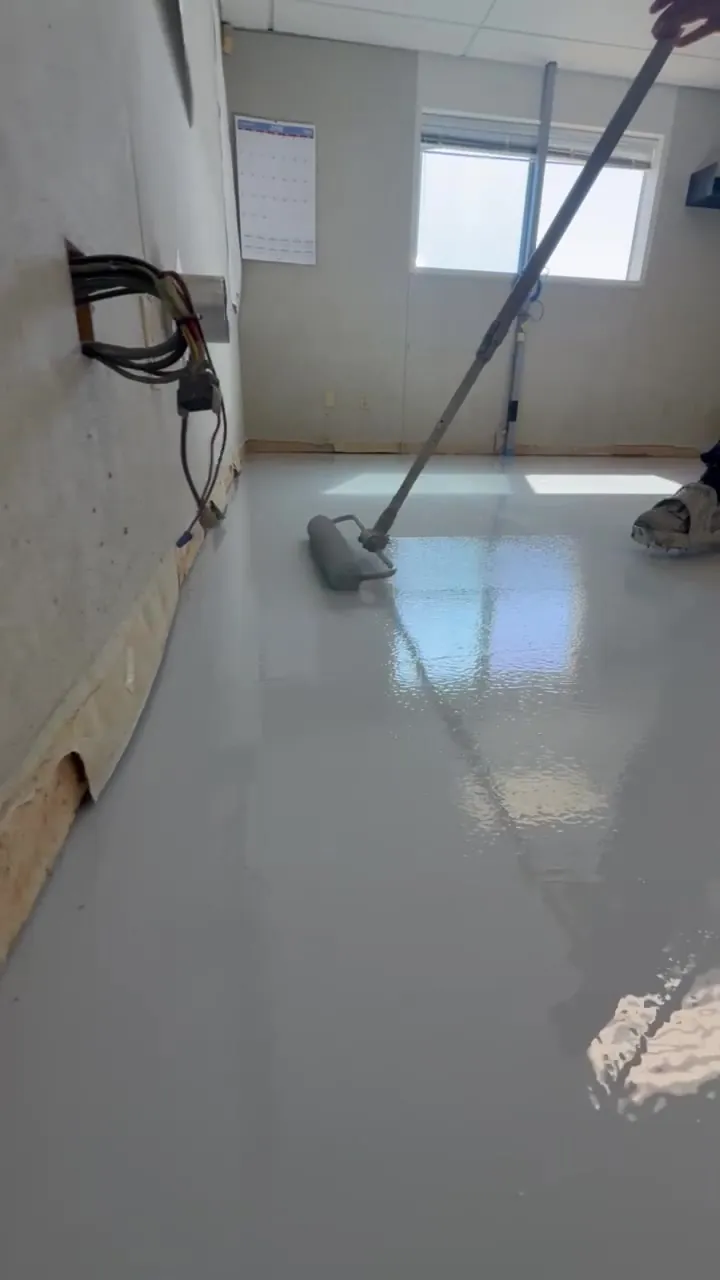
Once the flake had cured, we scraped the floor back flat and sealed it with a coat of polyaspartic.
Day three was the urethane topcoat. On a residential garage we’d normally stop at the polyaspartic sealer, but an office floor takes a very particular kind of punishment: chair casters rolling over the same four square feet eight hours a day, every day. A urethane topcoat adds abrasion resistance exactly where that wear happens, and it’s what lets a floor like this stay looking new for years rather than months.
Three Days, and Why It Takes Three
Worth being straight about the schedule, because it’s the first thing a business owner asks. Removal, prep and the vapor barrier took day one. The polyaspartic base, flake and sealer went in on day two. The urethane topcoat went on day three.
The work itself doesn’t take three days — the cure times do. Each layer has to be properly set before the next one can go over it, and rushing that is how you end up with a floor that fails early. A single-day residential garage is a different system on a different slab with no moisture barrier underneath it. For a commercial interior built this way, three days is the honest answer, and we’ll tell you that up front so you can plan around it.
Why Flake Floors Suit Commercial Spaces
A finished flake floor is seamless. There are no tile joints, no grout lines and no vinyl seams, which means there is nowhere for dirt, dust or spills to collect. Cleaning is a dust mop and a damp mop — no stripping, no waxing, no annual refinishing contract.
That’s the practical case, and in the Central Valley, where dust is simply part of life, it adds up fast. You can see more of this kind of work on our commercial floor coatings page and in the gallery. Every floor we install, residential or commercial, is backed by our warranty.
Got a Commercial Space That Needs a Floor?
Office, shop, warehouse or kitchen — we cover Bakersfield and the surrounding Kern County communities. Estimates take about 30–45 minutes and you’ll have a written quote before we leave. We respond within 15 minutes during business hours. Call or text 661-407-2661, or Get My Free Quote.
FAQ
Can you coat over old VCT tile instead of removing it?
No — the tile has to come out. A coating is only as sound as what it’s bonded to, and vinyl tile and its adhesive are not a surface that will hold a floor for twenty years. We remove the tile, deal with the adhesive underneath, and prep the bare slab before anything goes down.
Does my commercial floor really need a moisture vapor barrier?
We judge it floor by floor rather than adding it to every job as standard. What we look for are the signs: tile lifting or popping loose, adhesive staining, white powdery residue on bare concrete, a previous coating that bubbled. Any of those and the slab is telling you it’s pushing moisture. On this job the tiles had already started coming up, so the answer was obvious before we touched anything. If there’s any doubt we’ll say so at the estimate rather than guess.
How long will my business be shut down?
For a system like this one, plan on three days for the room being coated — most of that is cure time between layers, not crew time. We can often work a room or a section at a time so the rest of the building keeps running, and we’ll lay out the sequence before we start so there are no surprises.
How much does a commercial floor coating cost in Kern County?
It depends on the square footage, what’s on the slab now, how much removal is involved, whether the floor needs a moisture barrier, and which system you go with. The only way to get a real number is a free on-site estimate — it takes about 30–45 minutes and you’ll have an exact written quote in hand before we leave.